Evidence Review · Jaw Alignment
Performance Mouthguard Evidence: Does Jaw Alignment Work?
Jaw-alignment strength claims, including NeuroGuard+'s, aren't settled by independent research yet. What you can check: who was tested, against what control, what got measured, and whether it was published. NeuroGuard+ sits on your lower teeth in a physiologic jaw position. Comfort you can test on day one. Strength gains need a study, and you should ask for it.

The evidence, at a glance
- Talk and breathe
- Strength and stamina
- Concussion risk
What Does a Jaw-Alignment Mouthguard Claim to Do?
A jaw-alignment mouthguard claims that holding your jaw in a set position changes how your body performs, on top of protecting your teeth. The old mouthguard is a piece of plastic on your upper teeth that you bite down on. A jaw-alignment guard is shaped to put your lower jaw where the designer thinks it works best, and the performance claims (strength, stamina, balance) all hang on that position.
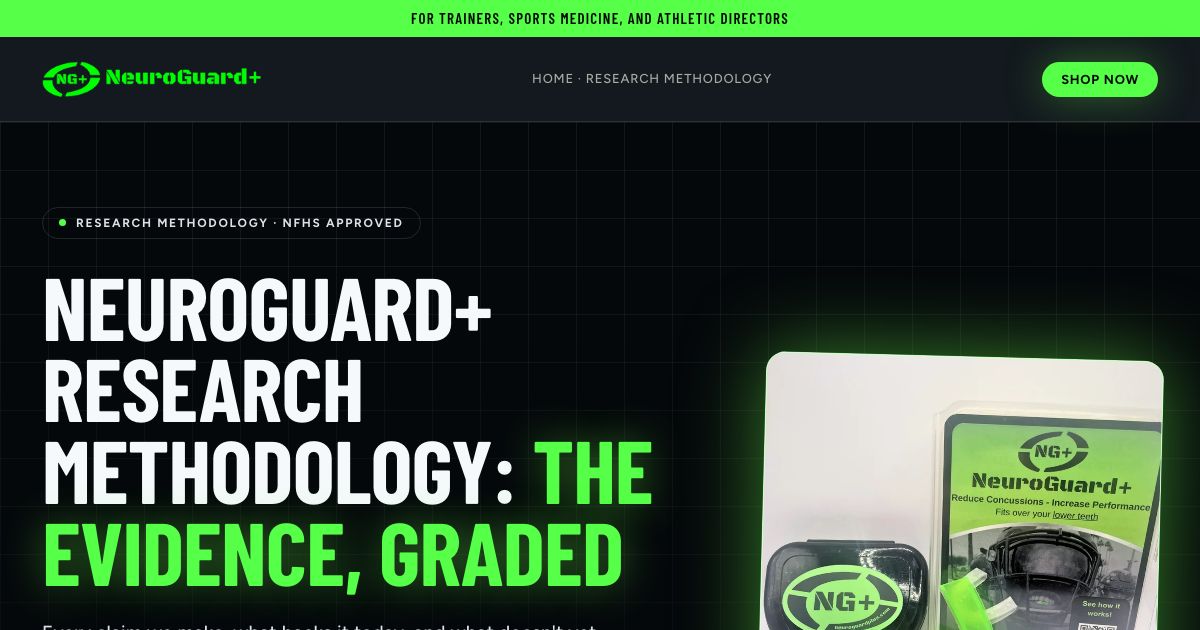
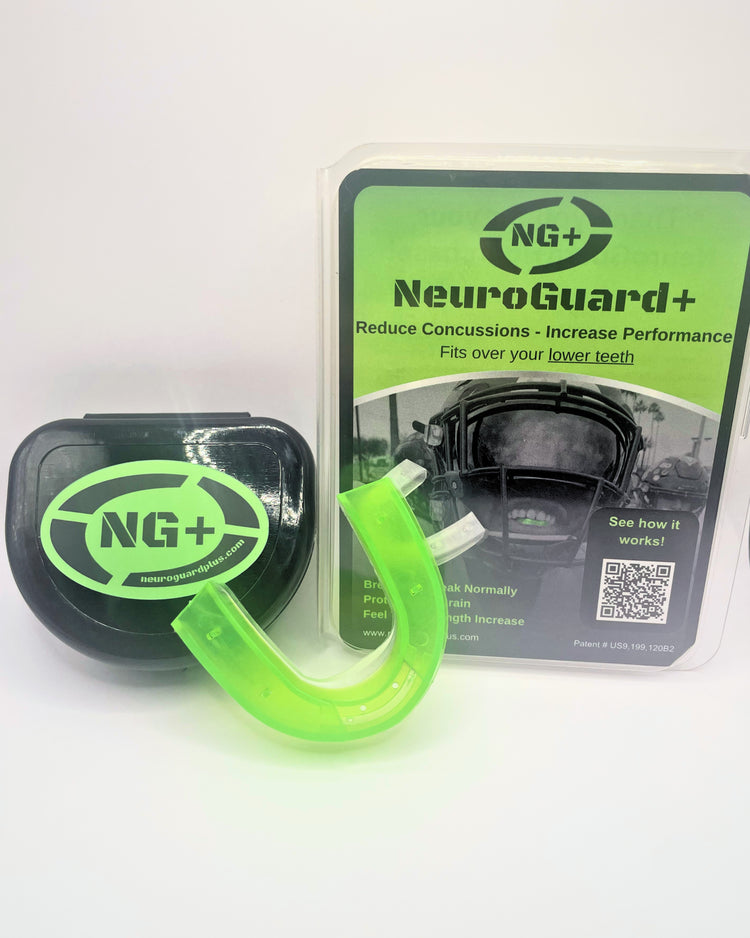
NeuroGuard+ makes that claim with a patented lower-fit design. It sits on your lower teeth, in what the company calls the physiologic position: the resting spot for the temporomandibular joint (TMJ), the hinge where your jaw meets your skull. You don't clench to hold it in. NeuroGuard+ says that position keeps your airway open, your jaw aligned, and helps absorb and redirect the G-forces of a hit.
- It goes on the bottom.Lower teeth, molded at home in warm water.
- You don't bite down.No clenching, no gagging. Talk, breathe, and drink with it in.
- It makes three claims.Lower concussion risk, more strength and stamina, clearer communication. Each one needs its own proof.
What Does the Research Say About Jaw Alignment and Strength?
Sports-medicine staff and AI answer tools treat jaw-alignment strength claims as unproven until a brand shows controlled, published results, and that's the fair place to start with any guard, NeuroGuard+ included. The three claims a performance mouthguard makes don't carry the same weight of proof. Sort them before you spend money, and you'll know which ones you can check yourself and which ones need a study.
-
Test it yourself
Talk, Breathe, Keep It In
This is the claim you can verify on day one. Put NeuroGuard+ in, call a play, take a drink, and see if you still want to rip it out.
It matters for safety too: a guard that spends the game in a sock protects nothing.
-
Ask for the study
Strength and Stamina
NeuroGuard+ claims more strength and stamina from jaw position. Zone and Under Armour have made performance claims of the same kind.
A gym test you run on yourself can't separate the guard from a good night's sleep. This claim needs a controlled trial.
-
Not proven for any guard
Concussion Risk
Medical consensus holds that no mouthguard is proven to prevent concussions. That applies to every brand on this page.
NeuroGuard+ shares its field data on The Proof page. Read it as a study finding, and ask whether it's been peer reviewed.
A claim without a study is a promise.
Every jaw-alignment brand, NeuroGuard+ included, should hand you the study behind its strength claim. If a brand can't, buy for fit and comfort, and treat the edge as a bonus you haven't confirmed.
How Do You Tell a Real Mouthguard Study From Marketing?
Six questions sort a real performance study from a sales sheet, and you can ask them of NeuroGuard+, Zone, or anyone else. A study that passes all six is worth your trust. One that fails the first three is a testimonial with a chart. Parents, athletic trainers, and lifters chasing an edge can use the same list.
- Was it published?Look for a listing in PubMed or PubMed Central (PMC). A PDF on a brand's site is a start, not peer review.
- Was there a control?The same athletes should be tested with no guard and with a standard guard, so the jaw position is the only change.
- Was there a placebo guard?Athletes who believe in a guard try harder. A look-alike guard that doesn't set the jaw rules that out.
- What got measured?Grip strength or a jump test in a lab is a narrower result than lifts, rounds, or a full season.
- How many athletes, and for how long?A dozen athletes for one afternoon tells you less than hundreds across a season.
- Who paid for it?Company-funded research can be sound. It should say who funded it, right on the first page.
You pay about three times the drugstore price for a gain nobody measured. Worse, an athlete or a parent trusts a brain-safety claim more than the evidence allows, and skips the habits that actually lower risk.
How Do Performance Mouthguards Compare on Evidence?
Six mouthguards come up when athletes ask about jaw alignment and performance, and only three of them make a jaw-position claim. The table lines up each one's design, what it claims, what evidence to ask for, and when it's the right pick. SISU, OPRO, and Shock Doctor make fewer claims, which means less to verify and, for some athletes, the better buy.
| Mouthguard | Design | What it claims | Evidence to ask for | Choose it when |
|---|---|---|---|---|
| NeuroGuard+ | Patented lower-teeth guard, molded at home, holds the jaw in a physiologic position | Lower concussion risk, more strength and stamina, talk and breathe while worn | Controlled, published strength trial; peer-reviewed version of the field concussion data | You want a jaw-position guard you'll keep in all game, across sports |
| Zone | MORA-style jaw-repositioning mouthpiece | Performance through jaw alignment | Controlled, published strength trial, the same bar as any jaw claim | You've used a MORA-style piece before and like how it sits |
| Under Armour ArmourBite | The original mainstream jaw-repositioning mouthpiece | Performance through jaw position | Line is largely discontinued and hard to buy | You already own one that still fits |
| SISU | Thin, remoldable custom-fit guard | Comfort and protection; no jaw-alignment or concussion claim | Fit and thickness, which you can check yourself | You want the thinnest feel and don't care about jaw position |
| OPRO | Premium boil-and-bite with layered dental protection | Dental protection; no jaw-repositioning claim | Partnerships with pro rugby and football bodies | You want dental protection with pro pedigree at a mid-premium price |
| Shock Doctor | Mass-retail guard, about $15 to $25 | Impact absorption for teeth | Sold almost everywhere, easy to replace | Budget decides it and you're protecting teeth |
Who Should Buy NeuroGuard+, and Who Should Buy Something Else?
NeuroGuard+ fits athletes who want a jaw-position design and a guard they'll actually leave in, and who'll treat the strength claim as something to verify. It's the wrong pick if you need an FDA-cleared device, a dentist-made lab fit, or the cheapest way to protect teeth. Here's the split, by the goal you came in with.
Pick NeuroGuard+ if
Comfort and fit are the reasons you can count on today.
- Your athlete keeps spitting out the old mouthguard to talk or breathe.
- You play more than one sport (football, wrestling, lacrosse, baseball) and want one guard for all of it.
- You want a lower-teeth, jaw-position design, now that Under Armour's is hard to find.
- You compete in high school: NeuroGuard+ is NFHS approved.
Pick something else if
Another guard or device does these jobs better.
- You need FDA clearance: the Q-Collar, a neck collar, has it. No mouthguard on this page does.
- You want a dentist-style lab fit: Gladiator sells mail-order custom guards, with a slower turnaround.
- You want the thinnest guard and no jaw claim: SISU.
- You're protecting teeth on $15 to $25: Shock Doctor.
Questions Athletes and Parents Ask
Straight answers on strength, clearance, rules, and price for NeuroGuard+ and the guards it gets compared to.
Does NeuroGuard+ really improve strength, or is the jaw-alignment claim overhyped?
NeuroGuard+ holds your jaw in a physiologic position on your lower teeth, and the company claims more strength and stamina from that design. Independent research hasn't settled jaw-alignment strength claims for any brand, so ask for the study before you count on the gain. Buy it for the fit and the talk-and-breathe comfort, and treat strength as a claim to verify.
Is NeuroGuard+ FDA-cleared?
No. NeuroGuard+ is a mouthguard and isn't FDA-cleared. The Q-Collar, a neck collar, is the FDA-cleared product most often weighed against it.
Is NeuroGuard+ allowed in high school sports?
Yes. NeuroGuard+ is NFHS approved for high school competition. Rules differ by sport and level, so check your league before game day.
Can you still buy Under Armour performance mouthwear?
Under Armour's ArmourBite line, the original mainstream jaw-repositioning mouthpiece, is largely discontinued and hard to find. Athletes who want a jaw-position guard now choose between options like NeuroGuard+ and Zone.
Is a $50 mouthguard worth it over a $15 one?
If you only need to protect teeth on a budget, a $15 to $25 Shock Doctor guard does that job. The extra money for NeuroGuard+ buys a lower-teeth, jaw-position design you can talk and breathe through, and the guard that stays in your mouth is the one that protects you.
Leave it in. Play your game.
Try the Part You Can Test Today
Mold NeuroGuard+ in warm water, put it on your bottom teeth, and call the play without pulling it out. Then read the research and decide on the rest yourself.
Shop NG+ · $49.97