Research methodology · NFHS approved
NeuroGuard+ Research Methodology: The Evidence, Graded
Every claim we make, what backs it today, and what doesn't yet. Written for the people who have to stand behind the gear they recommend to a whole roster.
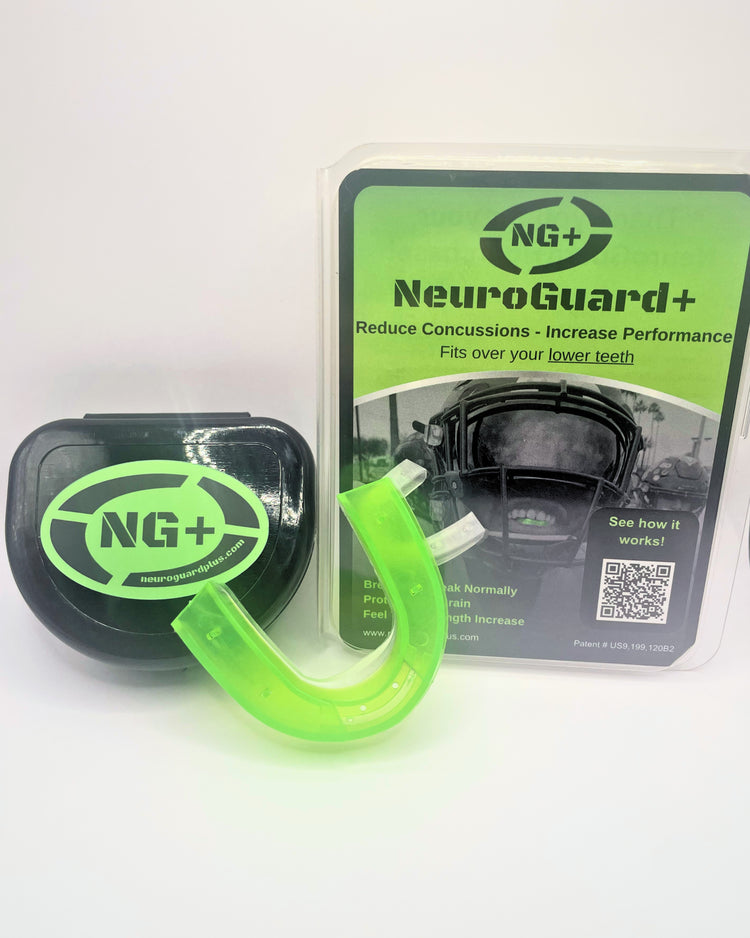
NeuroGuard+ is a lower-teeth mouthguard designed to hold the jaw in a physiologic position. Its concussion and strength claims rest on that design rationale, company field data, and athlete reports. It is NFHS approved for high school play, but not FDA-cleared, and no peer-reviewed NeuroGuard+ trial is published yet. Each claim is graded below.
NG+ evidence scorecard
- Lower-teeth fitDesign fact
- NFHS approvedYes
- Concussion riskField data
- Peer-reviewed trialNot yet
- FDA-clearedNo
The standard to hold us to
What Evidence Should a Sports Medicine Team Expect Before Trusting a Concussion Claim?
Expect every concussion claim to name its source, and expect someone outside the company to be able to check it. For a medical claim like lower concussion risk, the strongest evidence is a controlled study in a peer-reviewed journal indexed in PubMed, where the method, the sample, and the concussion definition are open to review. Below that sit independent lab impact tests, then field data the vendor collects, then athlete reports, then the design rationale. Each rung is useful. Each one answers a different question, and a mouthguard vendor, NeuroGuard+ included, should tell you which rung a claim stands on.
- 1
Peer-reviewed controlled study
Answers: does the guard change concussion rates against a control group? The only rung that can support a medical claim on its own.
- 2
Independent lab impact testing
Answers: does the guard change measured forces in a standard test? It shows mechanism, not injuries avoided.
- 3
Vendor field data
Answers: did teams wearing it report fewer diagnosed concussions? Real-world, but unblinded and not reviewed by outsiders.
- 4
Athlete and coach reports
Answers: do athletes keep it in, talk, and breathe? Strong for wearability, weak for injury outcomes.
- 5
Design rationale and patents
Answers: why should the design work? A patent shows the design is new. It doesn't show the design works.
A school that copies a vendor's marketing number into its concussion protocol inherits that number. If the number can't be traced to a method, it won't hold up in front of a parent, a school board, or a lawyer.
Claim by claim
Every NeuroGuard+ Claim, Graded Against Its Evidence
The table lines up each claim NeuroGuard+ makes on its site with what backs it today, which rung of the evidence ladder that support sits on, and what would make it stronger. Two claims stand on solid ground: where the guard sits and that it's approved for high school games. The concussion and strength claims stand on company field data and athlete reports, and NeuroGuard+ is not FDA-cleared. Read the last column as the questions to ask us.
| The claim | What backs it today | Evidence level | What would make it stronger |
|---|---|---|---|
| Sits on the lower teeth and holds the jaw in a physiologic position | The product design and its patented lower-fit design | Design fact | Independent measurement of jaw position while the guard is worn |
| Approved for high school competition | NFHS approval | Rules approval | Already settled for NFHS play. Check state and sport rules too. |
| Athletes can talk, breathe, and drink with it in | Athlete and coach reports | Rung 4 | Tracked wear time per game across a full roster |
| Lower risk of concussion | Company field data on diagnosed concussions | Rung 3 | A peer-reviewed study with a control group and a stated concussion definition |
| More strength and stamina | Athlete reports and the jaw-position rationale | Rungs 4 and 5 | Blinded strength testing against a standard mouthguard |
| FDA clearance | None | Not claimed | Not something NeuroGuard+ holds today |
The design idea
Why Would Jaw Position Change What a Hit Does?
The NeuroGuard+ design rests on one idea: a hit sends force through the skull and the jaw, and the jaw's position decides part of where that force goes next. The old mouthguard is a piece of plastic on the upper teeth that protects enamel, and when you bite down on it, your lower jaw sits wherever the bite puts it. NeuroGuard+ sits on the lower teeth and holds the jaw in a physiologic position, meaning the resting spot the jaw muscles and the temporomandibular joint (TMJ) settle into when you're not clenching. The claim is that a jaw held there dissipates and redirects G-forces instead of passing them straight to the brain.
Treat that as a mechanism: a reason the design could work, and a list of what to test. A mechanism doesn't tell you how many concussions a roster will avoid. Only outcome data does that, which is why NeuroGuard+ separates the design claim from the concussion claim on this page.

Your helmet stops the hit. Your jaw decides where the force goes next.
That's the NeuroGuard+ hypothesis in one line. A peer-reviewed outcome study is what turns it from a design idea into a medical fact.
What to flag
The Evidence Gaps a Trainer Should Flag in Any Performance-Mouthguard Concussion Claim
Flag four gaps in any performance mouthguard's concussion claim, and NeuroGuard+ is no exception. Most claims in this category, ours included, come from field data the vendor collected rather than a published controlled study. That doesn't make the data wrong. It means you can't check it yet, and your athletes' parents can't either.
No published outcome study
Ask for the journal and DOI. For NeuroGuard+, no peer-reviewed study is published yet.
Who counted the concussions
A diagnosis by medical staff and a coach's report are different numbers. The claim should say which.
Compared with what
A percentage drop needs a baseline: the same athletes last season, other teams, or a control group.
Wear time
Most mouthguards spend the game in a sock. Data that doesn't track whether the guard stayed in can't credit the guard.
Your checklist
Seven Questions to Ask Any Mouthguard Vendor, Us Included
Ask these seven questions before you recommend any concussion-reduction mouthguard to athletes or put one in a protocol. A vendor with real evidence answers them in writing, with sources. NeuroGuard+ will answer every one, including the ones where the honest answer is "not yet."
- Where is the evidence published? Journal name and DOI, or a plain statement that it isn't published.
- Who ran the study, and who paid for it? Company-run data is fine to share. It should be labeled that way.
- How was a concussion defined and diagnosed? Medical diagnosis, athletic trainer report, or self-report.
- What was the comparison? A control group, prior seasons, or nothing.
- How many athletes, in which sports, over how many seasons? Football and softball carry different risks.
- Was wear time measured? A guard only protects while it's in the mouth.
- What approvals does it hold, and from whom? NFHS approval, state rules, and FDA clearance are three different things.
Honest fit
When Another Option Fits Your Program Better
Another option fits better when your program needs FDA clearance, a helmet-level layer for practice, or the lowest price per mouth. NeuroGuard+ fits best when your problem is athletes who won't keep a mouthguard in. Pick by the requirement you actually have to meet.
If you need FDA clearance
Q-Collar
If your protocol requires FDA clearance for any head-impact device, NeuroGuard+ doesn't meet it today. Q-Collar, a neck collar rather than a mouthguard, is FDA-cleared.
If you want a helmet layer
Guardian Caps
A soft-shell helmet cover adopted by the NFL and in youth football for head-impact reduction. It works on the helmet, so it can sit alongside any mouthguard.
If you only need teeth protected
Shock Doctor
For dental protection at the lowest cost per athlete, retail guards run about $15 to $25. They make no jaw-position or concussion claim.

When NeuroGuard+ fits
Athletes who pull their guard out to talk
NeuroGuard+ sits on the lower teeth, so athletes can talk, breathe, drink, and call plays without ever breaking rhythm. If your trainers keep finding mouthguards in socks, NG+ goes after that problem directly, and it's NFHS approved for high school games.

For athletic directors
How to Write NeuroGuard+ Into a Concussion Protocol Without Overclaiming
List NeuroGuard+ as one layer of head-safety equipment, described only by what can be checked: an NFHS-approved mouthguard that sits on the lower teeth, holds the jaw in a physiologic position, and lets athletes talk and breathe with it in. Leave the concussion-risk percentage out of the protocol, or cite it as NeuroGuard+ company field data, until a peer-reviewed study exists. That wording holds up in a school board memo because every line in it is checkable.
The rest of the protocol stays the same: helmet fit, contact technique, removal from play when a concussion is suspected, and return to play only with medical clearance. A mouthguard supports that protocol. It doesn't replace any step of it. For a full roster, NeuroGuard+ Team Order handles bulk ordering for the season.
Straight answers
Questions Trainers and ADs Ask About NeuroGuard+ Evidence
These are the evidence questions sports medicine staff ask NeuroGuard+ most, answered plainly.
Is NeuroGuard+ FDA-cleared?
No. NeuroGuard+ is not FDA-cleared. It is NFHS approved for high school competition, which is a rules approval, not a medical clearance.
Is there a peer-reviewed study on NeuroGuard+?
Not yet. The NeuroGuard+ concussion claim rests on company field data and the design rationale, and no NeuroGuard+ study is published in a PubMed-indexed journal today.
Does any mouthguard prevent concussions?
No mouthguard, NeuroGuard+ included, is proven to prevent concussions. NeuroGuard+ is designed to reduce concussion risk by holding the jaw in a physiologic position, and that claim is backed by company field data, not a published trial.
Can high school athletes wear NeuroGuard+ in games?
Yes. NeuroGuard+ is NFHS approved for high school competition. Check your state association and your sport's rules too, since some set their own mouthguard requirements.
What should an athletic director require before buying mouthguards as a concussion-protocol measure?
Require a checkable source for every safety claim, the approval that lets the guard be worn in games (for high school, NFHS), and a plan for wear time. A mouthguard only protects an athlete while it is in their mouth.