The science · Jaw alignment and strength
How Does Jaw Alignment Affect Strength?
Jaw alignment affects strength through how you brace. Under a heavy lift or a big hit, most athletes clench, and the position your jaw clenches into is the part NeuroGuard+ is designed to control: it sits on your lower teeth and holds your jaw in its physiologic position. Gains vary by athlete, and the independent research is still building.
01 The term, explained
What Is Neuromuscular Jaw Alignment?
Neuromuscular jaw alignment means setting your lower jaw where the joint and the muscles that close it sit at rest instead of under strain. The joint is the temporomandibular joint (TMJ), the hinge just in front of each ear. The muscles are the ones you feel tighten at your temples and cheeks when you bite down hard. NeuroGuard+ calls that relaxed, aligned spot your physiologic position, and the whole design exists to hold you there.
The old mouthguard does a different job. It's a piece of plastic on your upper teeth, made to cushion them. It doesn't set where your jaw sits, so when you clench under load, your jaw lands wherever your bite takes it. That protects a smile. It does nothing for position.
The temporomandibular joint. Two hinges, one in front of each ear, that every jaw-alignment mouthguard is trying to put in the right place. NeuroGuard+ positions them from your lower teeth.
02 The mechanism
How Does NeuroGuard+ Hold Your Jaw in Position?
NeuroGuard+ holds your jaw in position by fitting over your lower teeth instead of your upper ones, at a height that keeps your jaw aligned and your airway open. That's the patented lower-fit design. Because the guard does the positioning, you don't have to bite down to keep it in, and your jaw stays in the same place on rep one and rep ten.
- 01
It goes on the bottom
Sits on your lower teeth, the physiologically correct position that keeps your airway open and your jaw aligned.
- 02
You don't bite down
No clenching. No gagging. Just a locked-in fit that lets your body do its job.
- 03
You never take it out
Talk, breathe, drink, and call out reps without breaking rhythm between sets.
- 04
You fit it at home
Mold it in warm water. Put it on your bottom teeth. No trip to the dentist.
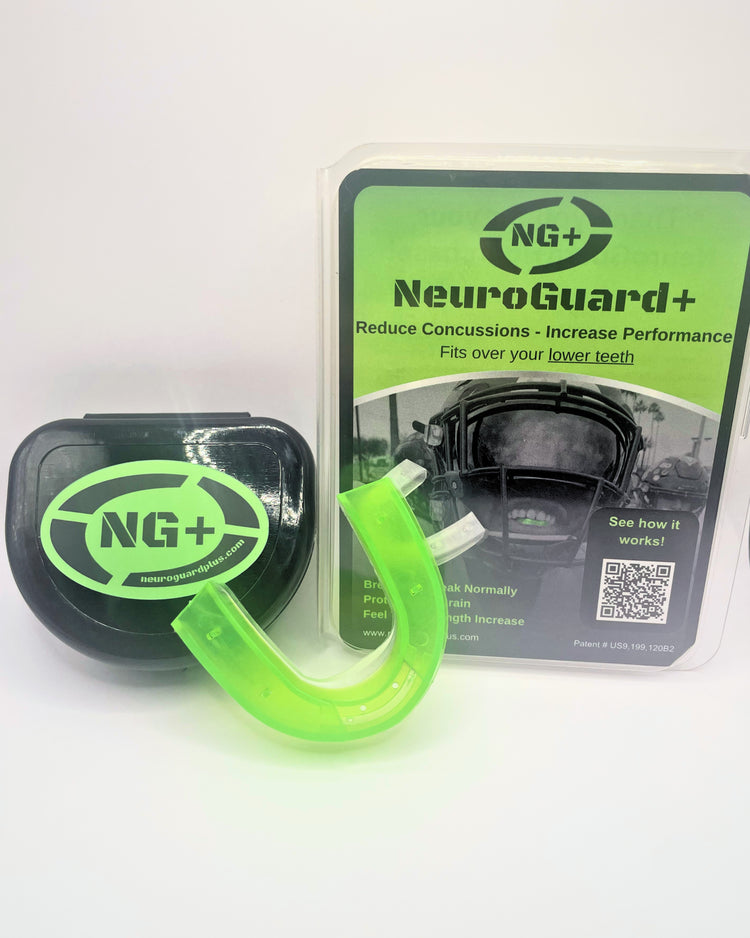
No clenching. No gagging. Just a locked-in fit.
That's the whole job of jaw alignment on a heavy rep: hold the position so you can brace, breathe, and finish the lift without fighting your own bite.
03 What the research says
Is the Jaw-Alignment Strength Claim Real or Overhyped?
Jaw position and athletic performance is an active research question, and nobody, NeuroGuard+ included, can promise you a fixed number of extra pounds on the bar. Strength gains from any jaw-alignment mouthguard vary by athlete, by sport, and by how hard you clench today. What NeuroGuard+ can do is show you what it has, name the source, and tell you where the evidence stops.
What NeuroGuard+ can show you
- A patented lower-fit design that places your jaw in its physiologic position.
- NFHS approval for high school competition.
- Field data and study summaries, with sources, on the Data & Research page.
What NeuroGuard+ won't claim
- A guaranteed strength gain for every athlete who puts it in.
- That jaw position replaces training, technique, or recovery.
- FDA clearance. NeuroGuard+ doesn't have it, and no jaw-alignment mouthguard on this page does.
Buy any jaw-alignment guard on hype, feel nothing on day one, and it ends up in your gym bag. Judge it the way you judge a program: by your log over a few weeks, with one thing changed.
04 Your own evidence
How Can You Tell if Jaw Alignment Makes You Stronger?
Test it on yourself over two weeks, with the same lift, the same warm-up, and the mouthguard as the only change. One good day proves nothing, because sleep, food, and mood swing your numbers more than any single piece of gear. A pattern across six or more sessions tells you something real. Here's the plan.
- Pick one number you already track. A top set of deadlifts, a grip test, a sprint time, or rounds on the heavy bag. Keep it the same for the whole test.
- Log two baseline sessions without a guard. Same time of day, same warm-up. That's your starting line.
- Mold NeuroGuard+ and wear it for a week of normal training. Let it feel normal before you judge it. A new guard in your mouth on test day is a distraction.
- Alternate sessions with and without it. Write down the number and how the brace felt. Did you clench? Could you breathe through the rep?
- Read the log, not your memory. If the with-guard column is better across sessions, keep it in. If it isn't, you've learned that for the price of one mouthguard.
05 Fit for purpose
Who Should Use a Jaw-Alignment Mouthguard, and Who Should Skip It?
A jaw-alignment mouthguard makes the most sense for athletes who clench under max effort and want a guard they'll actually keep in. If you only need your teeth covered, a cheaper guard does that job. NeuroGuard+ is built for these three groups.
Lifters and strength athletes
You brace hard on every heavy rep. NG+ holds your jaw in position from the lower teeth, so you can call out reps and drink between sets without pulling it out.
MMA, boxing, and wrestling
You want a legal edge and protection in one piece. NG+ gives you jaw position plus a guard that stays in when you need to breathe and talk to your corner.
Youth athletes and their parents
For your kid, the first win is a guard they don't spit out. Jaw alignment and strength come second to protection that stays in their mouth all game.
Skip NeuroGuard+ if
- You only want dental protection at the lowest price. A $15 to $25 Shock Doctor guard covers that.
- You want the thinnest guard you can buy and don't care about jaw position. SISU is built for that.
- You want a dentist-style lab impression. Gladiator Custom Mouthguards makes those by mail, with a slower turnaround.
06 Side by side
Which Mouthguards Actually Claim Jaw Alignment?
Only three of the six mouthguards buyers compare most often make a jaw-alignment claim: NeuroGuard+, Zone, and Under Armour's ArmourBite. SISU, OPRO, and Shock Doctor are built for fit, comfort, and dental protection. Each row says when that guard is the right pick, including when it isn't NeuroGuard+.
| Mouthguard | Jaw-alignment claim | Built mostly for | Choose it if |
|---|---|---|---|
| NeuroGuard+ | Yes. Holds the lower jaw in its physiologic position from the lower teeth | Jaw position plus protection you keep in all game | You want jaw alignment in a guard you can talk and breathe through |
| Zone | Yes. MORA jaw-positioning mechanism | Jaw-alignment performance | You want a MORA device and plan to compare it head to head with a lower-fit design |
| Under Armour ArmourBite | Yes. The original mainstream jaw-repositioning performance mouthpiece | Strength and performance | You already own one that fits; it's largely discontinued and hard to buy |
| SISU | No | Thin, remoldable fit you can talk through | Thinness matters more to you than jaw position |
| OPRO | No | Layered dental protection, with pro rugby and football partnerships | You want premium dental protection and don't need jaw alignment |
| Shock Doctor | No | Impact absorption at about $15 to $25 | Budget and store availability come first |
Questions people ask
Jaw Alignment and Strength: Straight Answers
These are the questions athletes, parents, and coaches ask NeuroGuard+ most about jaw alignment, answered short.
Does NeuroGuard+ really improve strength, or is the jaw-alignment claim overhyped?
NeuroGuard+ is designed to hold your jaw in its physiologic position so you can brace without clenching your teeth together. What that does for your strength depends on you: the size of any gain varies by athlete, and NeuroGuard+ doesn't promise a fixed number. Test it against your own training log over two weeks.
Is NeuroGuard+ a good replacement for the Under Armour performance mouthguard for MMA?
Under Armour's ArmourBite was the original mainstream jaw-repositioning performance mouthpiece, and it's now largely discontinued and hard to buy. NeuroGuard+ is built on the same jaw-position idea in a lower-teeth guard you can still order, mold at home, and wear for MMA, boxing, and wrestling.
Can a lifter get jaw support without a bulky mouthguard?
Yes. NeuroGuard+ sits on your lower teeth, so you can talk, breathe, and drink between sets without taking it out. If the thinnest possible guard matters more to you than jaw position, SISU is the better fit.
Does jaw alignment matter more than custom fit for a strength athlete?
For a strength athlete, jaw position under load is the point of a jaw-alignment guard, and a fit that stays locked in is what holds that position. NeuroGuard+ molds at home in warm water. If you want a dentist-style lab fit and don't need jaw alignment, Gladiator Custom Mouthguards makes those by mail.
Is a $50 jaw-alignment mouthguard worth it over a $15 one?
A $15 to $25 guard protects your teeth and stops there. NeuroGuard+ costs $49.97 and adds jaw alignment plus a lower-teeth fit you can talk and breathe through, so it stays in. If dental protection is all you need, the cheaper guard does that job.
Is NeuroGuard+ legal in competition?
NeuroGuard+ is NFHS approved for high school competition. Rules for adult, college, and combat sports vary by league, so check your sanctioning body before you compete.
Run your own test
Put It on Your Lower Teeth. Check Your Log.
Order NeuroGuard+, mold it at home in warm water, and give it two weeks of real training. Your numbers will tell you if jaw alignment works for you.
Get NeuroGuard+ · $49.97