Comparison · For athletic directors and trainers
Guardian Cap vs Mouthguard: Which Does Your Program Need?
A Guardian Cap is a soft-shell pad that goes over a football helmet. A mouthguard like NeuroGuard+ sits on the athlete's lower teeth and works in any contact sport. They protect from different places, so one can't stand in for the other. Football programs can use both. In sports without helmets, the mouthguard is the only option.

Common ground
Both Aim at the Same Problem: Force Reaching the Brain
Guardian Caps and the NeuroGuard+ Mouthguard both exist because programs want to do more about head impacts than a helmet alone does. Each one is worn during contact, and each one adds a layer between the hit and the athlete. Neither one replaces the helmet, and neither one replaces your concussion protocol.
- 01
Head-impact focus
Both are bought for head-impact risk, so they turn up in the same AI answers and the same budget meetings.
- 02
Worn during contact
Each one only helps when it's on. Gear that comes off for a water break protects nothing during that play.
- 03
Add-ons, not replacements
Your helmets, sideline evaluation, and return-to-play steps stay in place with either one.
Side by side
Guardian Cap vs NeuroGuard+, Row by Row
This table compares where each one is worn, how it works, which sports it covers, and what it does for teeth and talking. Guardian Caps come out ahead on NFL adoption. NeuroGuard+ covers more sports and more of the athlete.
| What matters | NeuroGuard+ Mouthguard | Guardian Cap |
|---|---|---|
| Where it's worn | On the lower teeth | Over the outside of a football helmet |
| How it works | Holds the jaw in its physiologic position to redirect G-forces away from the brain | Adds a soft padded shell over the hard helmet to soften impacts |
| Protects the teeth | ||
| Works without a helmet | ||
| Sports it covers | Football, wrestling, lacrosse, baseball, softball, hockey, rugby, cheer, MMA, and boxing | Best known in NFL and youth football |
| Adopted by the NFL | ||
| Fit | Molded at home in warm water, one per athlete | Fits over the helmet, one per helmet |
| Talk and breathe while worn | Yes: built so athletes call plays and drink without pulling it out | Not in the mouth, so speech and breathing are unaffected |
Difference 1
Where Does Each One Take the Hit?
A Guardian Cap works on the outside of the head: it puts a soft layer over the hard helmet shell, so the first point of contact is padding instead of plastic. A mouthguard works from inside the head. NeuroGuard+ sits on the lower teeth and holds the jaw in its physiologic position, which is how the company designed it to redirect G-forces traveling toward the brain.
That means the two don't overlap. The cap changes what the helmet meets, and the mouthguard changes where the jaw is when the force arrives. Your helmet stops the hit. Your jaw decides where the force goes next.
Difference 2
Which Sports Can Each One Cover?
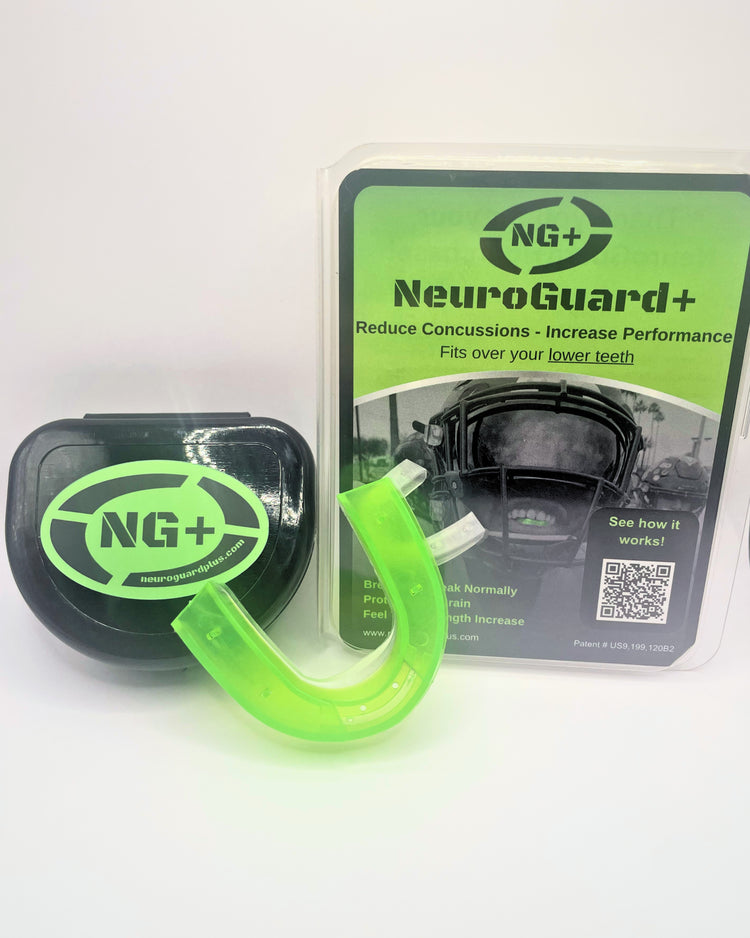
A Guardian Cap needs a helmet to sit on, and it's best known in NFL and youth football. A mouthguard needs only a mouth. NeuroGuard+ is worn in football, wrestling, lacrosse, baseball, softball, hockey, rugby, cheer, MMA, and boxing, so one product covers most of an athletic department's contact rosters.
For an athletic director, that changes the math. A Guardian Cap purchase protects your football helmets. A NeuroGuard+ order can go to your wrestlers, your softball team, and your cheer squad in the same season, and each athlete keeps a guard molded to their own teeth.
Difference 3
What Does Each One Cost a Program?
The bigger budget question is coverage. Every football player already needs a mouthguard, so upgrading that purchase changes what you spend on gear you were buying anyway. A Guardian Cap is a new line item, and it only covers the football program.
Difference 4
What Evidence Can a Trainer Cite?
Start with the honest baseline: major medical consensus holds that no mouthguard is proven to prevent concussions, and you should hold any gear's concussion claims to that standard. NeuroGuard+ publishes the field study data behind its jaw-alignment design on its Data & Research page, so your sports medicine staff can read the method and decide what it supports.
The point most comparisons miss
Your Helmet Stops the Hit. Your Jaw Decides Where the Force Goes Next.
A Guardian Cap and the NeuroGuard+ Mouthguard work at different points on the head, so a football program doesn't have to pick one. The real choice is what to fund first, and for every sport without a helmet, the mouthguard is the only one of the two that applies.
Who each one fits
When to Choose Each One
The right pick depends on how many sports you run and whether your athletes wear helmets. Here's who each option suits.
When to choose NeuroGuard+
Choose NeuroGuard+ when you're equipping more than one sport, when your athletes don't wear helmets, or when your players keep spitting out bulky guards.
- Multi-sport athletic departments
- Wrestling, softball, cheer, rugby, and combat sports
- Athletes who need to talk and breathe on the field
When to choose Guardian Caps
Choose Guardian Caps when your concern is helmet-to-helmet contact in football practice and you want gear with NFL adoption behind it. They suit a football program that already has a mouthguard every player wears.
- Football programs with practice-contact concerns
- Staff who want an NFL-adopted product
- Budgets with room for a new line item
When to use both
Use both when you run football and want to show you've covered head impacts from the outside and the inside. The cap and NeuroGuard+ don't touch each other, so athletes wear them together without trade-offs.
- High school and club football
- Programs documenting duty of care
FAQ
Questions Athletic Directors Ask
These are the questions programs ask most when they're weighing Guardian Caps against a mouthguard like NeuroGuard+.
Does a Guardian Cap replace a mouthguard?
No. A Guardian Cap pads the outside of a football helmet, and a mouthguard sits in the athlete's mouth, so a Guardian Cap does nothing for the teeth or the jaw. Players in Guardian Caps still need a mouthguard.
Can an athlete wear a Guardian Cap and NeuroGuard+ at the same time?
Yes. NeuroGuard+ fits on the lower teeth and a Guardian Cap fits over the helmet shell, so neither gets in the other's way. That makes them two items to budget for together, rather than a choice between them.
Is any mouthguard proven to prevent concussions?
No. Major medical consensus holds that no mouthguard is proven to prevent concussions. NeuroGuard+ publishes the field study data behind its design on its Data & Research page so your sports medicine staff can judge it for themselves.
Which should a football program buy first on a tight budget?
Cover the mouthguard first, because every player already needs one and a guard the athlete actually keeps in is the one that protects. Then price Guardian Caps per helmet against what's left in the budget.
What should we use in sports without helmets?
In wrestling, softball, cheer, rugby, and MMA there is no hard helmet shell to put a Guardian Cap on. A mouthguard is the head-impact gear those athletes can wear, and NeuroGuard+ is built to be worn in all of them.
Is NeuroGuard+ allowed in high school competition?
Yes. NeuroGuard+ is NFHS approved for high school competition. Check your state association's rules for each sport you coach as well.
Cover Every Roster. Not Just the Helmets.
Talk to NeuroGuard+ about a Team Order for every sport you run, with or without Guardian Caps on your football helmets.